If your website is live, looks professional, but your inbox is still quiet, you probably do not have a design problem.
You have a structural problem.
A local service business website has one job: turn the right visitors into estimate requests, calls, and booked work.
That does not happen just because the colors are clean, the photos look good, or the homepage says “quality service.” Homeowners contact a contractor when the website quickly answers their real questions:
Do you offer the service I need?
Do you work in my area?
Can I trust you inside or around my home?
What happens if I request an estimate?
If those answers are unclear, slow, generic, or buried, the visitor does not study the website. They leave.
And in local service businesses, that usually means the job goes to someone else.
The Real Issue: The Site Was Built as a Page, Not as a Sales Path
Many contractor websites are built like digital brochures.
They introduce the company, list a few services, show some photos, and place a contact form somewhere near the bottom. On the surface, nothing looks broken.
But the sales path is weak.
A homeowner looking for exterior painting, bathtub refinishing, sunroom construction, remodeling, cleaning, landscaping, or another home service is usually not browsing casually. They are comparing options and trying to reduce risk.
If they cannot understand your service area quickly, they may assume you do not serve them.
If your services are grouped together without clear separation, they may not see the exact solution they need.
If your reviews, project examples, licensing, insurance, warranty, or process are weak or hidden, they may not feel enough confidence to contact you.
If requesting an estimate on mobile feels frustrating, many visitors never reach the form.
This is where many professional-looking websites fail: they look finished, but they do not guide the customer from search intent to trust to action.
Why Expensive Websites Still Miss the Business Logic
The market is full of attractive websites that cost thousands of dollars and still fail to generate consistent inquiries.
The problem is rarely design quality alone. The problem is that many websites are built around aesthetics first and customer intent second.
A polished layout does not automatically understand which service makes the highest profit, which neighborhoods matter most, what homeowners in that market worry about, or why a $7,000 project requires more trust than a $200 service call.
A design agency can create a strong visual presentation and still miss the commercial path.
If your exact service radius is not obvious within seconds, a high-intent homeowner can leave for a competitor who makes it clear.
If your best services are buried under one generic “Services” page, search engines and customers both receive weaker signals.
If the website does not show proof before asking for action, the estimate form becomes a dead end.
The issue is not whether the website was cheap or expensive.
The issue is whether it was built to support how customers actually choose a local service provider.
Why SEO Needs a Proper Website Foundation
Buying SEO for a poorly structured website is like pouring premium fuel into a broken engine.
You may increase activity, but the system still cannot convert properly.
Local SEO depends on structure. Search engines need to understand what services you offer, where you offer them, and which pages deserve to rank for specific commercial searches.
Users need the same clarity.
If your website sends every service, city, project, and estimate request through one generic path, you make both jobs harder. Search engines have less to work with. Visitors have more friction. Your SEO budget starts fighting against the website instead of building on it.
That is why website development and Local SEO should not be treated as separate, disconnected tasks.
For a local service business, the website itself is the foundation.
If that foundation is weak, more traffic often exposes the weakness instead of solving it.
What the Sunroom and Bathtub Projects Showed
Two projects show how this works in practice.
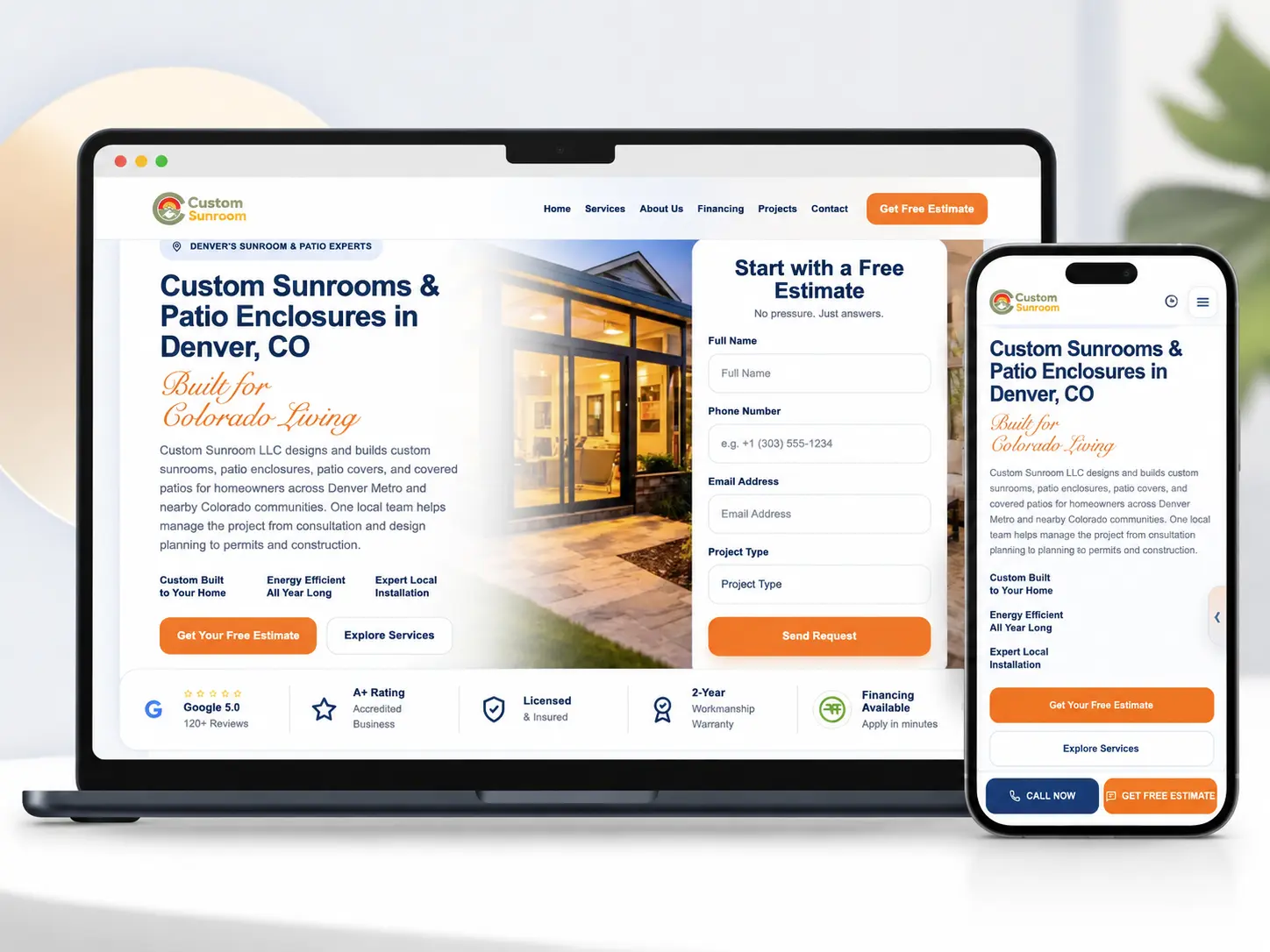
Custom Sunroom LLC
The challenge was not visibility.
The company already had legitimate experience, completed projects, financing options, and multiple service lines. The problem was that homeowners arriving on the website often saw several similar offerings — sunrooms, patio enclosures, patio covers, and covered patios — without immediately understanding which solution matched their situation.
That confusion matters because homeowners rarely request estimates when they are unsure which service they actually need.
The website was rebuilt around homeowner intent rather than internal company terminology.
Instead of forcing visitors to navigate through overlapping services, each major offering received a dedicated path supported by project examples, financing information, local service coverage, and clear estimate actions. The homepage was simplified so visitors could identify the right solution faster and move directly into the inquiry process.
Performance remained exceptionally strong, with PageSpeed scores reaching 100 on desktop and high-90s on mobile, but speed was not the primary objective.
The real objective was reducing decision friction.
A homeowner considering a $20,000–$60,000 outdoor living project does not submit an estimate request because a website looks modern. They submit it when they clearly understand the solution, trust the company, and feel confident taking the next step.
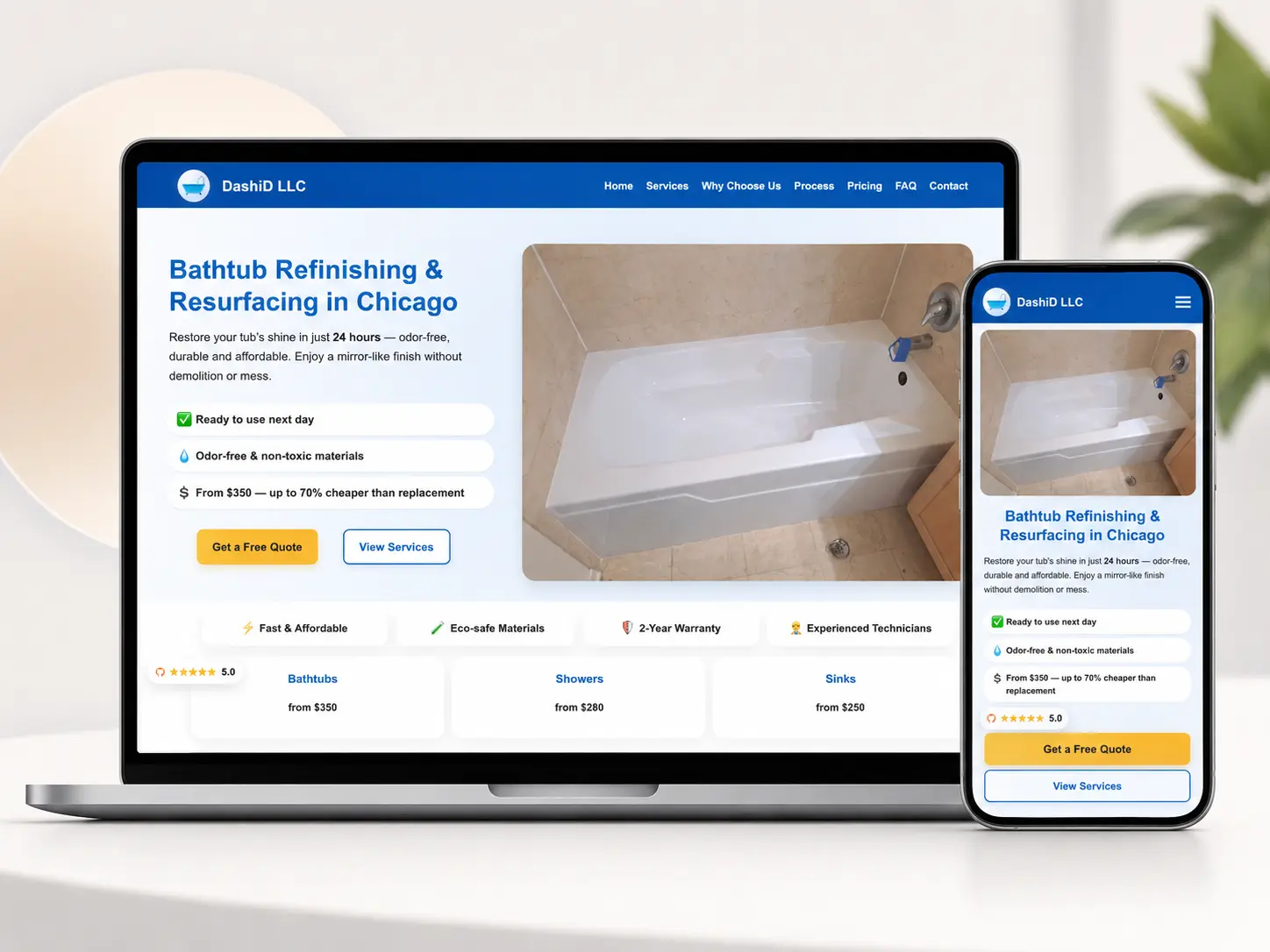
Chicago Bathtub Refinishing Project
The bathtub refinishing project had a different sales problem.
Homeowners were not only asking, “Can you refinish my tub?”
They were comparing refinishing against replacement. They had concerns about durability, surface quality, downtime, odor, and whether the lower price would still produce a professional result.
A generic service page would not handle those concerns well.
The structure had to address the core customer anxiety directly: why refinishing can make sense when replacement is expensive, disruptive, or unnecessary.
Starting rates were made clear, including bathtub refinishing from $350 and tile refinishing from $280. That matters because price clarity reduces hesitation for homeowners who are already comparing options.
The mobile path was also tightened so visitors could move from interest to estimate request without unnecessary friction. PageSpeed reached 98 on mobile, helping the site avoid the delays that often cause visitors to abandon service pages before taking action.
The commercial point was not simply “the website is fast.”
The point was that the website answered the right concerns, showed enough clarity to build trust, and made the next step easy.
That is what a service business website is supposed to do.
When a Business Needs Website Development Before More Traffic
More traffic is not always the next move.
If your website already gets visitors but does not produce calls or estimate requests, the problem may be conversion structure.
If people land on your site and still cannot quickly understand your services, service area, pricing signals, proof, or process, more visitors may only create more missed opportunities.
If your SEO is not moving, the issue may not be effort. It may be that the website does not give search engines enough clean structure to rank the right pages for the right searches.
If your site looks fine but produces weak leads, vague inquiries, or no inquiries at all, the website may need to be rebuilt as a commercial system before you spend more money trying to drive traffic into it.
A good-looking website can still be a poor sales asset.
For local service businesses, that difference matters every day.
Stop Guessing Why Your Website Is Not Booking Jobs
A professional look will not fix broken commercial architecture.
If your traffic is not converting, you are losing money every day your website stays in its current condition.
The next step is not to randomly change a headline, redesign a button, or buy more traffic. The next step is to look at the structure: service pages, Local SEO foundation, trust signals, mobile path, speed, and the journey from first visit to estimate request.
StartWebTop reviews local service business websites from that angle.
Not as decoration.
As a sales system.
If your website looks fine but does not bring the inquiries your business needs, start with a website audit and find out where the commercial path is breaking.